Benue Applauds ECOWAS for Economic Empowerment of IDPs
 Tamenor Kwaghzer
Feb 12, 2026 01:24
499
0
Tamenor Kwaghzer
Feb 12, 2026 01:24
499
0
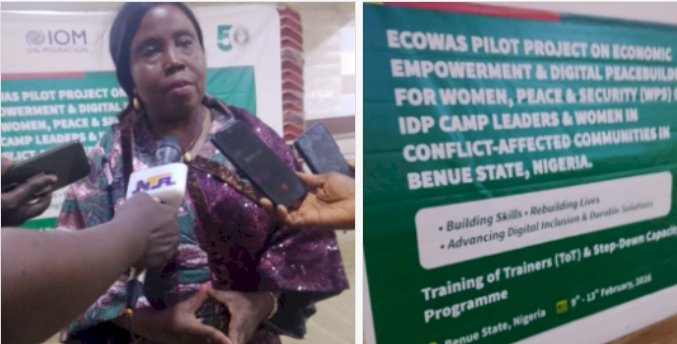
The Benue State Government has commended the Economic Community of West African States (ECOWAS) for training Internally Displaced Persons (IDPs) in the state.
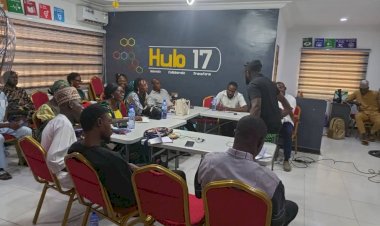
Declaring open the five-day capacity-building workshop titled “ECOWAS Pilot Project on Economic Empowerment and Digital Peace Building for Women, Peace and Security (WPS) Community-Based Organizations in Benue State, Nigeria,” Governor Hyacinth Alia thanked the regional body for empowering the displaced population through the programme.
Represented by the Secretary to the State Government (SSG), Deborah Serumun Aber, Esq., Governor Alia acknowledged that the initiative would serve as a lifeline and help mitigate hardship among displaced persons. He appreciated ECOWAS for shifting its focus to IDPs in Benue State.
Describing the programme as “laudable” for addressing humanitarian challenges, the Governor dismissed suggestions that ECOWAS had abandoned displaced persons in the state.
Addressing ECOWAS officials, he said, “You might still have chosen to go another way, but you are here in Benue today.”
According to him, ECOWAS’ presence in the state demonstrated that, notwithstanding decades of seeming abandonment of displaced communities, its decision to train selected participants,.who would in turn train the larger IDP community for knowledge acquisition and transfer across various communities, was a positive response.
Governor Alia stated that empowering women always yields positive outcomes. He noted that the microfinance model currently in vogue evolved from engagement with women, adding that such interactions have enhanced the economic lives of women globally.
He expressed confidence that ECOWAS’ intervention would improve the wellbeing of the displaced population and assured that his administration would ensure the success of the programme.
The Governor also unveiled the Benue Action Plan to the regional authority to facilitate humanitarian recovery. The plan, also known as the “Durable Solutions” framework for the IDP crisis, serves as a roadmap for skills acquisition, empowerment, peace promotion, and reconciliation as pathways for displaced persons to return to their ancestral homes.
He urged ECOWAS officials to visit IDP camps to obtain firsthand information about the humanitarian situation in the state.
Responding, the Director of Humanitarian and Social Affairs of the ECOWAS Commission, Dr. Sintiki Tarfa Ugbe, explained that Benue State was selected for the pilot workshop because it already has a durable solutions action plan for displaced populations.
“We selected Benue State of Nigeria for this pilot workshop because the state has its durable solutions action plan for displaced populations,” she said.
She noted that ECOWAS’ involvement in the state’s durable solutions plan could help reduce prolonged displacement.
Under the circumstances, she said, ECOWAS would support the transition of displaced persons from dependency to recovery while building resilience to enable them to rebuild their lives.
“This durable solution aligns with the ECOWAS regional action plan for development. We will work together with humanitarian partners for the recovery of affected communities, and this is why we are here,” she added.
Dr. Ugbe explained that ECOWAS collaborates with United Nations partners such as the International Organization for Migration (IOM), state governments, representatives of the Federal Government from the Ministries of Women Affairs and Foreign Affairs, as well as Nigeria’s Permanent Mission to ECOWAS, to address humanitarian concerns.
She clarified to the Benue State Government that ECOWAS’ intervention was driven by the understanding that continuous aid alone was not the best solution for displaced populations. Rather, transitioning people toward recovery and building resilience to strengthen economic prosperity remained the preferred option.
The Director further stated that the pilot project was designed not only for economic empowerment but also for peacebuilding, noting that economic activities cannot thrive in the absence of peace.
Dr. Ugbe described peacebuilding, economic empowerment, and humanitarian support as vital components for the development of women.
“When you touch one life, you are not just touching one life. If it is a woman, the touch extends to the children, the husband, and the community,” she said. “In the humanitarian sphere, when you empower one woman in a household, you are indirectly impacting several households.”
To ensure the training reaches a wider displaced population across the state, she disclosed that twelve female directors from civil society organizations would be trained to cascade knowledge to sixty women from various IDP camps, who would in turn train others to guarantee maximum impact.
She concluded that although ECOWAS usually provides transportation stipends to participants during engagements, one encouraging development has been that women—known for strong managerial skills—often reinvest such stipends into the overall wellbeing of their families.