At 30, Swem Karagbe Club Calls for Tiv Unity, Stronger Federal Action on Benue Security
 Tamenor Kwaghzer
Feb 16, 2026 04:53
197
0
Tamenor Kwaghzer
Feb 16, 2026 04:53
197
0
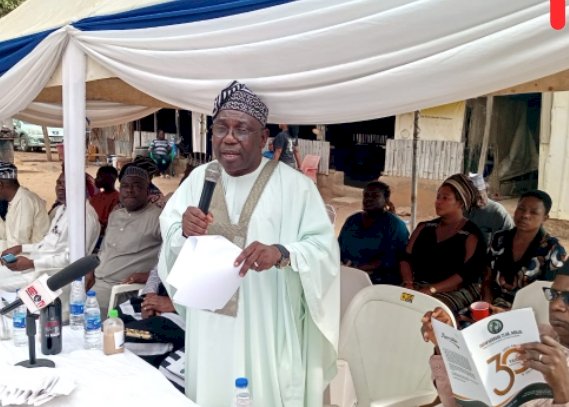
The Swem Karagbe Club has celebrated its 30th anniversary in Abuja, using the occasion of its 2025 Annual General Meeting to press for deeper unity among Tiv elites, increased youth involvement in leadership, and decisive federal intervention to address the persistent insecurity in Benue State.
The socio-cultural organisation, founded in August 1996 by six associates as the “Committee of Friends,” has evolved into a structured body now comprising 35 members.
Addressing participants at the anniversary gathering on February 14, 2026, the Club’s President, Jacob Kajo, recounted the group’s transition to the Swem Karagbe Club, explaining that the name is rooted in Tiv history and represents the ideals of truth and objectivity associated with traditional oath-taking.
He recalled that membership rose swiftly from six to 11 within the first month and later reached the constitutional maximum of 30 during the tenure of the pioneer leadership led by Sir Michael Ucha.
Kajo attributed the Club’s enduring stability to the groundwork laid by its first Executive Committee, which produced the maiden constitution, adopted the motto “A Friend in Need is a Friend Indeed,” designed the Club’s logo and regalia, inaugurated a Board of Trustees, secured registration with the Corporate Affairs Commission, and obtained a permanent site in the Federal Capital Territory.
Presently, the Club functions through four standing committees: Cultural, Welfare, Investment and Public Relations, and operates both a Bam savings scheme and a Cooperative Society to support members’ financial wellbeing.
On infrastructure development, the president disclosed that the group has completed a functional hall and temporary rental units at its Abuja property. He added that plans are in progress to sink a borehole, build shops and develop a modest guest house to enhance sustainable revenue generation.
Even as members celebrated the milestone, Kajo raised concern over the ageing composition of the Club following the death of some pioneer members. He urged the body to deliberately admit credible younger members to ensure continuity and smooth leadership succession.
Chairman of the occasion, Godwin Tyoachimin, applauded what he described as three decades of purposeful and visionary leadership, pledging his continued support for the Club. He further called on Tiv people at home and in the diaspora to unite and project a stronger collective voice in Nigeria’s political and economic space.
A major feature of the event was the presentation of a paper titled “The Role of the Elite in Addressing Security Challenges in the Middle-Belt–Tiv Nation” by Dr. Cletus Akwaya, Publisher and Editor-in-Chief of DAILY ASSET Newspaper.
Akwaya described the Club’s survival over three decades as significant, noting that many socio-cultural organisations within Tiv society have struggled to remain cohesive over time. However, he said the subject of insecurity in Tivland continues to evoke painful memories due to the scale of human and material losses.
Providing historical context, he observed that although farmer-herder tensions predate Nigeria’s civil war, the violence escalated sharply around 2011, becoming more coordinated and lethal. By 2019, attacks had affected 14 of Benue’s 23 local government areas, including Guma, Makurdi, Gwer West, Kwande, Logo, Katsina-Ala and Agatu.
He pointed to mass killings, destruction of homes and farmlands, and large-scale displacement of communities. According to him, the number of internally displaced persons peaked at about 1.6 million in 2022 but has reportedly reduced to approximately 600,000 as some displaced families gradually returned.
Akwaya criticised what he termed the politicisation of insecurity by some Tiv elites, accusing certain political actors of exploiting the crisis for electoral advantage rather than presenting a united demand for decisive federal intervention.
He nevertheless acknowledged the roles played by organisations such as the Mutual Union of Tiv in America (MUTA), the Mutual Union of Tiv in the United Kingdom (MUTUK), the Christian Association of Nigeria (CAN), Catholic bishops in affected dioceses, and traditional rulers who supported community-based vigilante initiatives.
The paper also reviewed measures taken by successive Benue administrations under Gabriel Suswam, Samuel Ortom and Hyacinth Alia, including the Anti-Open Grazing Prohibition and Ranching Development Act of 2017 and the establishment of security outfits such as the Livestock Guards and the Benue Volunteer Civil Protection Guards (Anyam Nyor).
Despite these efforts, Akwaya lamented that the crisis has persisted for nearly two decades, with far-reaching humanitarian and economic consequences, including the destruction of markets, schools, health facilities and churches.
To stem the tide, he advocated improved coordination among Tiv elites through a depoliticised framework. He proposed that the umbrella body, Mdzough U Tiv (MUT), should create or strengthen the office of a Tiv National Security Secretary to drive a unified strategy.
He also recommended harmonising security approaches across administrations, reviewing the Anti-Open Grazing Law for greater effectiveness, strengthening village-level vigilante structures, establishing state police, and deploying additional military formations along Benue’s borders with Nasarawa and Taraba states.
Other suggestions included youth economic empowerment through cooperative systems, revitalisation of Tiv cultural consciousness to deepen solidarity, strategic media engagement for sustained advocacy, and support for emerging platforms such as Tiv TV established by the Tor Tiv, Professor James Ortese Iorzua Ayatse.
In his remarks, Kajo also commented on recent national economic developments, particularly the Tax Reform Acts of 2025, which took effect on January 1, 2026. While noting that the reforms are intended to widen the tax net, boost government revenue and support small businesses, he expressed concern over possible increases in tax burdens and consumer prices.
He urged the Federal Government to implement the reforms in a manner that will stimulate economic recovery and improve living standards, stressing that a stable economy would enhance members’ capacity to save and invest through the Club’s financial platforms.
As it enters its fourth decade, the Swem Karagbe Club reaffirmed its commitment to cultural preservation, mutual support, economic empowerment and sustained advocacy for peace and security in Benue State and across the Tiv nation.